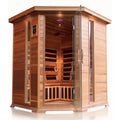
Home Infrared Sauna: How to Pick the Right One in 2026
Share
More people are quietly canceling their spa memberships and gym sauna passes in favor of a home infrared sauna, carving out a corner of a basement or spare bedroom to build a real recovery ritual. The shift makes practical sense: once you own a unit, you can use it daily without driving anywhere, and the ongoing cost drops to electricity alone. At Wholesome Living Solutions, we've spent years sourcing and testing spa-grade infrared units built for everyday home use. What we've found is that the buying decision is more nuanced than most product pages let on. The type of infrared, the heater design, the wood species, and the EMF output all affect how much you'll actually use the unit and whether you'll see results. This guide walks you through every decision point so you know exactly what to buy and why.
What a home infrared sauna is (and why it feels different from a traditional one)
How infrared heat works
Traditional saunas heat the air around you to 170, 200°F using convection. Your body warms as a secondary effect of sitting in that hot air. Infrared saunas work differently: they emit radiant energy that penetrates body tissue directly, much like the warmth of standing in sunlight but without UV exposure. The cabin air temperature runs 110, 150°F, which is considerably lower, but the sweat response and perceived depth of heat are often comparable to a conventional steam room.
Why the lower temperature matters for daily use
Lower ambient heat means most people can comfortably sustain 20, 45 minute sessions without feeling suffocated. There's no steam, no humidity, just dry radiant heat penetrating tissue directly. That combination makes daily use genuinely realistic rather than an occasional post-gym treat. An at-home infrared sauna is designed to be used consistently, and its lower temperature threshold is a feature, not a compromise.
How it fits into a home versus a gym or spa
Most infrared cabin models require no plumbing, no steam generator, and no specialized ventilation. A standard bedroom corner, basement wall, or home office space works fine for a single-person unit. Setup time is typically a few hours, and most 1, 2 person models run on a standard 120V household outlet. That accessibility is what makes the infrared format so well suited to everyday homeowners who don't want a renovation project.
Health benefits that clinical research actually supports
Cardiovascular and circulation benefits
The strongest research on sauna use comes from cardiovascular studies. A long-term Finnish cohort study found that people using saunas 4, 7 times per week had up to 50% lower risk of fatal cardiovascular events compared to those using them less than once weekly. Sessions elevate heart rate and dilate blood vessels in ways that studies published in Frontiers in Cardiovascular Medicine have compared to moderate aerobic exercise. Consistent use has also been linked to improvements in blood pressure and endothelial function, which is meaningful for sedentary adults or those recovering from injury.
Pain relief, muscle recovery, and mental health
Infrared heat penetrates up to 1.5 inches into muscle and dermal tissue, and small clinical trials and observational studies suggest it may help reduce inflammation and stiffness associated with conditions like fibromyalgia, arthritis, and chronic back pain, though evidence strength varies by condition and more large-scale research is ongoing. Beyond physical recovery, clinical data also points to lower cortisol levels, boosted endorphins, and improved sleep quality with consistent use. The mental health benefits are real and measurable, not just marketing language.
What research doesn't fully back
Detoxification claims, specifically the idea that sweating in an infrared sauna eliminates heavy metals at meaningful clinical levels, remain preliminary. Large-scale trials specifically testing infrared detoxification don't yet exist, and most robust sauna research focuses on traditional Finnish saunas rather than infrared-specific units. That's not a reason to dismiss the technology. Buy for the proven benefits: cardiovascular conditioning, pain management, and stress recovery. Treat broader detox claims as secondary rather than the central pitch. For an accessible clinical overview of infrared saunas and related recovery practices, see the Mass General overview.
Far infrared, near infrared, or full-spectrum: which one fits your goals
Far infrared: the most practical choice for home use
Far infrared (FIR) emits wavelengths in the 3,000, 10,000 nanometer range, penetrating 1.5, 2 inches into muscle and dermal tissue. It's the most studied infrared wavelength for therapeutic applications and covers the broadest set of use cases: chronic pain relief, cardiovascular conditioning, daily relaxation, and muscle recovery. Sessions run comfortably at 110, 140°F, making it the easiest entry point for first-time sauna owners. For most people, far infrared covers everything they need at a lower price point than more complex alternatives.
Near infrared and full-spectrum: more wavelengths, more complexity
Near infrared (NIR) operates at shorter wavelengths (700, 1,400 nm) and targets cellular repair, mitochondrial stimulation, and collagen production at the skin level. It's popular in biohacking communities for its potential anti-aging and recovery applications. Full-spectrum units combine near, mid, and far infrared to cover all tissue depths in a single session. The trade-off is that full-spectrum units cost more, sessions feel more intense (typically 20, 30 minutes versus 30, 45 for FIR), and not everyone actually needs the full wavelength range to meet their health goals.
How to choose a home infrared sauna type based on your actual goals
For pain relief, muscle recovery, cardiovascular health, and daily relaxation, far infrared covers most people's needs without overcomplicating the decision. If cellular repair, skin health, and biohacking protocols are central to your routine, near infrared or full-spectrum adds real value. Let your goals drive the budget, not the other way around. Don't pay for full-spectrum if far infrared addresses what you're actually trying to solve.
Buying a home infrared sauna: space and electrical requirements
Space requirements for portable versus cabin models
Portable infrared saunas (tents, blankets, pods) typically occupy around 4, 6 square feet of floor space, most single-person units measure roughly 30"×30" to 36"×36", and fold flat for storage. They're a workable option for small apartments or anyone not ready to commit to a permanent installation. Single-person cabin saunas typically require a 3×3 to 4×4 foot footprint (13, 16 sq ft) plus a few inches of clearance around the unit for airflow. Two-person models, commonly around 48" wide by 44" deep, need more room; a spare bedroom, a basement corner, or a dedicated wellness space is ideal.
Electrical requirements: simpler than most people expect
Most 1, 2 person infrared sauna cabins run on a standard 120V household outlet with a 15A circuit, the same type used by common household appliances. No electrician required. Larger hybrid units or traditional-style heaters may need a dedicated 240V circuit, but those are the exception for infrared-specific cabin models. For the vast majority of at-home infrared sauna buyers, plugging into an existing outlet is all the electrical planning needed.
Floor, ventilation, and placement basics
Level flooring is required, but no drainage, waterproofing, or concrete work is needed for standard infrared cabin models. Indoor placement applies to wood-frame units unless the model is explicitly rated for outdoor exposure. Adequate airflow in the room helps with comfort, but no dedicated ventilation system is required. Measure your target space carefully before purchasing, paying particular attention to ceiling height (most units sit just under 7 feet) and door access for assembly.
What separates a quality infrared sauna from a cheap one
EMF levels and safety certifications
Low EMF is non-negotiable for a product you'll sit inside for 30, 45 minutes daily. Many leading low-EMF models test below 1 mG at occupant distance; the industry benchmark for "low EMF" is under 3 mG, with ultra-low models coming in at 0.3 mG or less, verified by independent labs like Vitatech Electromagnetics. The key word is "verified": look for third-party EMF test reports, not manufacturer self-reporting. UL listing and low-VOC materials matter equally, since off-gassing inside an enclosed heated cabin is a genuine concern that cheap builds tend to ignore.
Wood type and build quality
Canadian hemlock is a widely used wood species for sauna construction, favored in the industry for being naturally low-resin, odorless under sustained heat, and dimensionally stable over years of regular use. Thin, lightweight panels are a reliable red flag. Quality cabin saunas use properly milled, sustainably sourced wood that holds heat without warping season over season. The single-person infrared sauna cabin at Wholesome Living Solutions is built from sustainably sourced Canadian hemlock with a 15-minute warm-up time, meeting the practical standard for what a spa-grade home unit should deliver from day one of installation.
Heater quality and warm-up performance
Carbon fiber panel heaters distribute heat more evenly across the body than ceramic rod heaters and consistently produce lower EMF output. A 15-minute warm-up time is the practical standard for daily use because a longer warm-up turns spontaneous sessions into a commitment rather than a habit. Watch out for units that advertise a maximum temperature without specifying how long they take to reach it or how evenly that heat distributes across the cabin interior. Both details matter for real-world session quality.
Warranty, return policy, and after-sale support
A 30-day risk-free return window is the clearest signal that a brand stands behind its product. High-ticket wellness purchases carry inherent hesitation, and a no-hassle trial period removes the financial risk that typically stalls buyers. Lifetime or multi-year warranties on heaters and wood panels signal manufacturer confidence in build quality. Brands that offer no test period deserve extra scrutiny: a quality infrared sauna should be experienced before you commit fully, and any brand confident in their product knows that.
How to make the final call
Work through the decision in order. Start with your primary health goals, pain relief, cardiovascular conditioning, stress recovery, or biohacking. Match the infrared type to those goals (far infrared covers most people; full-spectrum adds value for specific protocols). Confirm your space and electrical setup before you browse models. Then evaluate build quality over sticker price, prioritizing verified low-EMF output, quality wood construction, and carbon panel heaters.
Consistency matters more than specifications. The best home infrared sauna is the one you'll actually step into daily, not the one with the longest feature list. Comfortable session temperatures, a fast warm-up, and a build that holds up over years of regular use without off-gassing or warping: those are the factors that determine whether a unit stays part of your routine or collects dust.
At Wholesome Living Solutions, we built our line of single-person infrared sauna cabins around exactly those priorities: sustainably sourced Canadian hemlock, spa-grade far infrared performance, a 15-minute warm-up, and a 30-day risk-free return policy with free shipping to most Continental U.S. addresses. If you're ready to explore your options or have questions about which unit fits your space and goals, consult a best home sauna guide or reach out directly. We're here as a resource, not a sales pitch.